Archive / Findings
What the data proves
Four datasets survive in the web archive, all recovered separately: the catalogue, the review threads, the shop’s own published dispatch times, and the upload dates of its images. Read together they describe something none of them shows alone.
1. Everything breaks in October 2014
Four independent measurements, from four separate sources, converge on the same month.
| Measurement | Source | When it turns |
|---|---|---|
| Review volume peaks at 30 a month | Archived review threads | Oct 2014 |
| Dispatch time peaks at 8.69 days | The shop’s own metrics page | w/c 26 Oct 2014 |
| Last product image ever uploaded | WordPress upload folders | Oct 2014 |
| Performance reporting stops | The shop’s own metrics page | 9 Nov 2014 |
In the first week of September the shop was dispatching in 1.01 days, its best figure on record. Eight weeks later it was taking 8.69, while receiving more customer feedback than in any month of its existence. It never added another product. It stopped publishing its own numbers, on the reasonable-sounding grounds that reporting before orders completed “would be cheating”. Then it posted forecasts of a recovery it never evidenced.
The obvious reading is the human one. Demand outran one person’s capacity to pack parcels, and the operation never recovered its footing before the police arrived fifteen weeks later. That is an inference, not a proof, and it is labelled as one. The convergence of the four dates is the fact.
2. Upload folders date the range, and the method can be tested
WordPress files an uploaded image into a folder named for the year and month it was uploaded, and never moves it. That turns the shop’s image directory into a rough calendar of when each product line entered the catalogue.
It is only useful if it can be checked, so it was checked. If the method holds, no product should have a customer review dated before its image was uploaded.
| Product | Image uploaded | First review | Consistent? |
|---|---|---|---|
| Speed paste | Feb 2014 | Feb 2014 | Exact match |
| Cocaine (Colombia/Peru) | Dec 2013 | Dec 2013 | Exact match |
| Midazolam | Aug 2014 | Sep 2014 | Review follows |
| Diazepam | Jun 2014 | Sep 2014 | Review follows |
| Cocaine (Bolivia) | Dec 2013 | Oct 2014 | Review follows |
Five for five. No review predates its image, and in two cases the two coincide to the month. So an upload date is a reliable earliest bound on when a line appeared. It cannot prove a product launched that month, but it proves it did not launch before then.
3. On that basis: the pharmaceutical pivot
The shop did not start out selling medicines. It sold cocaine, methamphetamine, MDMA and speed for the first six months. Diazepam and zolpidem arrive in June 2014, alprazolam in July, and then in August a burst of five in a single month: bromazepam, clonazepam, lorazepam, midazolam and tramadol.
| Month | Images | What entered the range | |
|---|---|---|---|
| Dec 2013 | 10 | Cocaine and methamphetamine photography, plus the homepage carousel | The shop opens |
| Jan 2014 | 3 | MDMA, filed as "emma" | |
| Feb 2014 | 2 | Speed paste | Its review thread also begins this month |
| Mar 2014 | - | - | Nothing uploaded |
| Apr 2014 | 4 | Ecstasy: Chupa Chups, and an "Android" pill | |
| May 2014 | 1 | A "WiFi 200mg" pill | |
| Jun 2014 | 4 | Diazepam and zolpidem, Gold Bars, green Chupa Chups | Pharmaceuticals begin |
| Jul 2014 | 2 | Alprazolam, Lucky Clovers | |
| Aug 2014 | 7 | Bromazepam, clonazepam, lorazepam, midazolam, tramadol, Afghan hash | The pharmaceutical push |
| Sep 2014 | 1 | Moroccan Polm hash | |
| Oct 2014 | 5 | Burger King pill, Heineken, Ice-o-Lator, pink Chupa Chups | The last images ever uploaded |
| Nov 2014 | - | - | Nothing |
| Dec 2014 | - | - | Nothing |
| Jan-Feb 2015 | - | - | Nothing. The raid is 26 February |
By December the pharmaceuticals were nine of the twenty-eight listings, a third of the shop, all of them described as im Blister - EU Ware. A business that began as a drug shop had spent its second half becoming a grey-market pharmacy, and the shift happened in about ten weeks.
4. The shop window stopped being maintained
The homepage ran a full-width carousel. Comparing the captures shows it changed once and then froze.
| Capture | Slides | Captions | Change |
|---|---|---|---|
| 4 May 2014 | 10 | Koka, Koka2, Koka3, Meth1, Meth2, MDMA1, MDMA2 | - |
| 17 Sep 2014 | 8 | All removed but the first | Two dropped, one swapped |
| 4 Dec 2014 | 8 | All removed but the first | Identical to September |
Two things follow. First, between May and September the slide captions were stripped: a homepage that had literally labelled its images Koka and Meth1 stopped naming them. Second, the carousel was then untouched for the whole of the shop’s final quarter, while the catalogue behind it kept growing until October. The front of the shop was frozen while the back of it was still moving.
One consequence is visible on the site today. The December carousel was still promoting a pill photographed in May 2014 that has no listing in the December catalogue at all.
5. It had a Google Search Console account
This is the strongest single piece of evidence that the shop was doing deliberate search optimisation, and it survives in an unlikely place. Google Search Console keeps the record of submitted sitemaps against the property rather than the account, so verifying this domain in 2026 returned the submission history of everyone who has held it - including the shop.
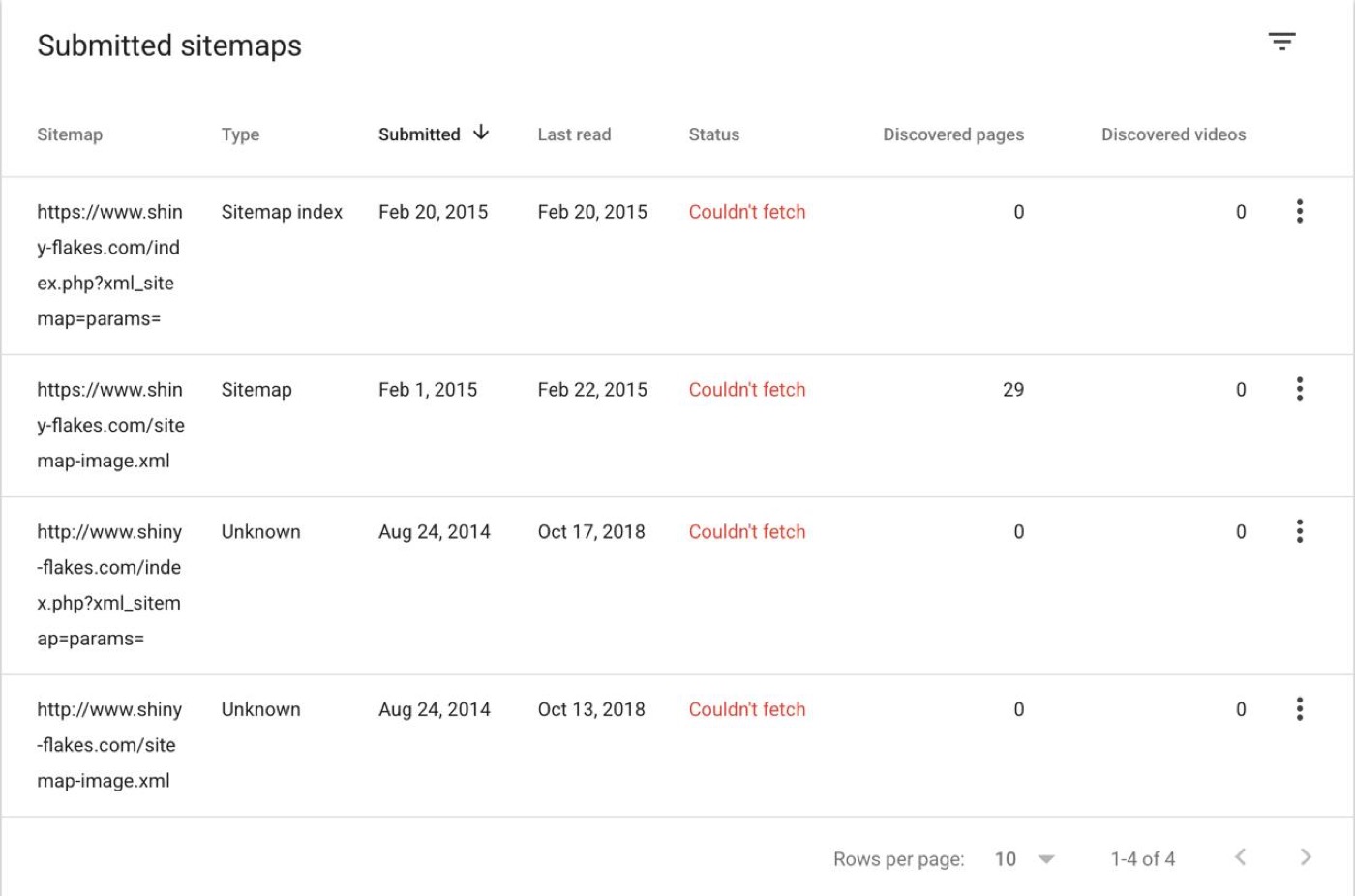
| Submitted | Sitemap | Pages found |
|---|---|---|
| 24 Aug 2014 | http://www.shiny-flakes.com/index.php?xml_sitemap=params= | - |
| 24 Aug 2014 | http://www.shiny-flakes.com/sitemap-image.xml | - |
| 1 Feb 2015 | https://www.shiny-flakes.com/sitemap-image.xml | 29 |
| 20 Feb 2015 | https://www.shiny-flakes.com/index.php?xml_sitemap=params= | - |
Four things follow, and none of them required any inference.
- It submitted itself to Google, on purpose. Not merely findable: registered, verified and actively telling Google what to crawl.
- It ran a separate image sitemap. That exists for one reason, which is to get photographs into Google Images. The product photography was not decoration.
- It dates the SEO push to a week. This archive had already established, from the page source, that the keywords tag appeared somewhere between 4 May and 17 September 2014. The first sitemap submission is 24 August 2014, inside that window. Two independent records, one narrow date.
- The last submission is 20 February 2015. Six days before the raid, it was still doing housekeeping on its Google listing.
The URL format is worth a note for anyone trying to reconstruct the software. A query-string sitemap at index.php?xml_sitemap=params= alongside a separate sitemap-image.xml indicates two older WordPress sitemap plugins running together, one general and one for images. This archive has not been able to identify either with confidence and does not name them.
Neither sitemap was ever captured by a web crawler, so their contents - the actual list of URLs the shop asked Google to index - are lost. The Search Console record is the only surviving trace that they existed at all.
6. A rating confirmed by two sources, three months apart
The shop reported its standing on Agora in two places. In the September 2014 interview with Motherboard the operator gives it as 4.992 von 5.000. On its own metrics page, captured 4 December, it reads Agora - 2500+ deals (4.993/5.000).
Trivial in itself, and useful for two reasons. It settles an ambiguity: written that way in German the figure could be read as 4,992 ratings out of 5,000, but a September value of 4.992 rising to a December value of 4.993 can only be an average out of five. And it is a small independent cross-check between a journalist’s notes and the shop’s own page, which agree.
What this archive could not establish
Negative results, stated because an archive that only reports its successes is not one.
- No price history. Only the December capture carries prices. The May, September and October captures of the homepage show no product prices at all, so nothing can be said about whether prices moved.
- No bitcoin address. No checkout page was ever crawled, so there is no seed for a blockchain trace. Set out in full here.
- The two orphan images are not proof of orphan products. An “Android” pill and a “WiFi 200mg” pill exist as image files with no matching listing, which looked like evidence of delisted lines. Checking the markup shows both were carousel slides. They may have been products; the archive cannot show it.
- No vendor-profile data. The shop’s claimed standing on Agora and Evolution cannot be verified independently. Surviving marketplace scrapes in the research literature do not include its profile.
- Two files known to have existed, never captured. A PGP public key at /SHINY_PUBLIC_KEY.txt, and cocaine_batch_info.txt, requested by a crawler in September 2014 and refused with a 403. So the shop published batch documentation, and what was in it is unknown.
Where the case sits in the literature
It reached policy research quickly. The Global Drug Policy Observatory at Swansea University published From Dealer to Doorstep: How Drugs Are Sold On the Dark Net in June 2015, three months after the seizure, citing the Forbes coverage of the photographs. The German proceedings are citable in their own right: the Federal Court of Justice decision of 5 November 2024 is reported as BGH, 05.11.2024 - 5 StR 599/23.
Everything on this page can be reproduced from public sources. The captures are in the Internet Archive, the case numbers are in the German court reporting, and the method is described above rather than asserted. Corrections and challenges are welcome.